Bishop Matthew Hassan Kukah and Professor Bart Nnaji Co-Chair Veritas University’s AI Enterprise to Tackle Poverty Across Africa
ABUJA, Nigeria — Veritas University, Abuja, the Catholic University of Nigeria, has established Veritas Enterprise, an artificial intelligence (AI)-driven business initiative aimed at tackling poverty, bridging the digital divide and expanding access to essential services across Africa.
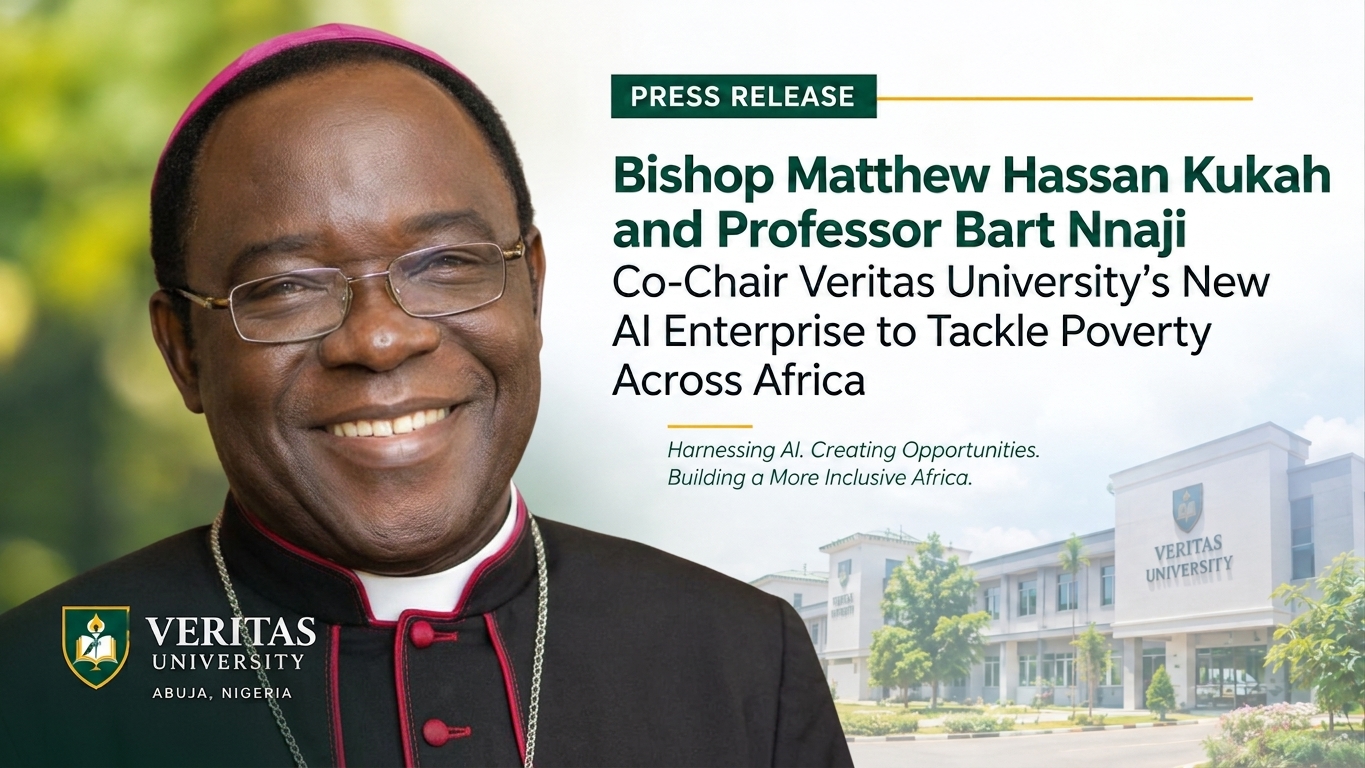
PRESS RELEASE
Bishop Matthew Hassan Kukah and Professor Bart Nnaji Co-Chair Veritas University’s AI Enterprise to Tackle Poverty Across Africa
ABUJA, NIGERIA — Veritas University, Abuja, the Catholic University of Nigeria, has established Veritas Enterprise, an artificial intelligence (AI)-driven business initiative designed to tackle poverty, bridge the digital divide and expand access to essential services across Africa.
The initiative seeks to harness artificial intelligence to create sustainable, profitable businesses that address pressing social and economic challenges, particularly in communities with limited access to reliable electricity, healthcare, finance, education, housing and markets.
Inspired by Pope Leo XIV’s Magnifica Humanitas, which calls on universities to take greater responsibility in shaping humanity’s future in the age of artificial intelligence, Veritas Enterprise aims to translate the principles of human-centred technology into practical economic opportunities for underserved populations.
To steer the initiative, the university has constituted a 13-member founding board co-chaired by Bishop Matthew Hassan Kukah, Catholic Bishop of Sokoto, and Professor Bart Nnaji, founder of Geometric Power Group and Professor of Robotics and Computer-Integrated Manufacturing at the University of Massachusetts Amherst.
Harnessing AI for Human Development
Veritas Enterprise is founded on the principle that technology must serve humanity and create meaningful opportunities for people, especially those who remain excluded from the benefits of technological advancement.
The initiative aims to mobilise Africa’s educational institutions, particularly faith-based universities and tertiary institutions, to equip young people with artificial intelligence skills, connect them with business opportunities and support the establishment of enterprises that respond to real community needs.
Its approach combines AI adoption, enterprise development, institutional partnerships and access to markets to create businesses capable of delivering measurable social and economic benefits.
The initiative will begin in Nigeria before expanding to other African countries.
A Sustainable Business Model for Poverty Reduction
A central principle of Veritas Enterprise is that businesses established to serve disadvantaged communities must also be commercially viable.
Rather than relying indefinitely on external financial support, the initiative seeks to establish enterprises that generate revenue, sustain their operations and expand their reach over time.
The model draws inspiration from the Catholic Church’s longstanding contribution to social and economic development through cooperatives, credit unions, schools and other community-based institutions.
It also reflects the experience of cooperative enterprises such as the Mondragon network in Spain, demonstrating how economic organisation can support livelihoods and broaden participation in productive activities.
Veritas Enterprise intends to extend this tradition into the digital economy by applying artificial intelligence to business creation, economic coordination and the delivery of essential services.
Free AI Training and Enterprise Development
A key component of the initiative is the University Enterprise Commons, a platform designed to connect tertiary institutions, students and staff with AI training, certification, business development opportunities and support for establishing enterprises.
Through the platform, students and staff are expected to access free AI training and certification while exploring opportunities to transform their knowledge and skills into productive ventures.
The initiative seeks to bridge the gap between acquiring digital skills and applying those skills to create jobs, businesses and solutions to community challenges.
By connecting education with entrepreneurship, Veritas Enterprise aims to help young people become active participants in the emerging AI-driven economy.
Expanding Access to Electricity and Essential Services
Reliable electricity is another major focus of the initiative. Veritas Enterprise plans to develop clean-energy solutions, beginning in Nigeria, with the objective of improving access to affordable and dependable power before extending the programme to other African countries.
Electricity is critical to the initiative’s broader ambitions because it supports digital connectivity, healthcare delivery, education, small businesses and other productive activities.
The enterprise also seeks to improve access to primary healthcare and economic opportunities by working through cooperatives, trade unions, educational institutions, government agencies, subnational governments and faith-based organisations.
These networks are expected to help extend the initiative’s reach to communities that conventional commercial models may struggle to serve.
Mobilising Africa’s Educational Networks
Veritas Enterprise plans to leverage Africa’s extensive faith-based educational infrastructure to expand access to digital skills and entrepreneurship opportunities.
According to estimates cited by the initiative’s proponents, approximately 675 faith-based tertiary institutions across Africa serve about three million students. The wider Catholic education system serves more than 71 million learners in approximately 231,000 schools and universities worldwide.
By working through these networks, the initiative hopes to establish a broad platform for delivering AI training, clean energy, primary healthcare and business opportunities to underserved populations.
Building on Veritas University’s Commitment to Human-Centred AI
The establishment of Veritas Enterprise builds on the university’s earlier engagement with the global conversation on responsible artificial intelligence.
On June 25, 2026, Veritas University signed the Humanitas AI Compact, becoming, according to the initiative, the first university in the world to sign the agreement.
The compact was signed by the university’s Vice-Chancellor, Rev. Fr. Professor Hyacinth Ichoku, before the university’s 154th Senate.
The Kukah Centre is the principal institutional partner of Humanitas AI, while Professor Emeka Aniagolu chairs its steering committee.
Veritas Enterprise is intended to move beyond declarations about ethical AI by establishing practical businesses through which the technology can deliver tangible benefits to households, farmers, healthcare providers, young people and other underserved groups.
Leadership and Strategic Direction
The initiative’s chief executive officer, Emmanuel Emeka Orjih, said Veritas Enterprise would translate the commitment to human-centred AI into enterprises capable of delivering practical economic and social benefits.
Orjih, an applied AI strategist, Wharton-trained MBA graduate and founding director of the Centre for AI, Digital Justice and Economic Rights, brings experience in social entrepreneurship and development finance. He has said his work has helped him finance and establish more than 18,000 enterprises.
“The first signing declared that AI must serve humanity,” Orjih said. “This second act builds the enterprises through which that commitment can reach a home, a clinic, a workshop, a farm and a young person seeking productive work.”
Other members of the founding board include Dr Sam Amadi, former chairman and chief executive officer of the Nigerian Electricity Regulatory Commission; Oluwatoyin Aralepo, director of Finance for West African Economic and Monetary Union and West Africa at Mastercard Foundation; Akinwande Pearse, a private-sector and finance adviser with the German development agency GIZ; and Michael Ibrahim Magaji, a former senior Citibank executive and regional director at Access Bank.
The board also includes Dr Margaret Ejima Akoje, bursar of Veritas University; Valentine C. Amadi, an international AI and technology executive with World Bank experience; Professor Paul Obo Idornigie, Senior Advocate of Nigeria; and Professor Gabriel Bassey Egbe.
Professor Nnaji brings expertise in robotics, manufacturing technology and power-sector development, while Bishop Kukah contributes his longstanding engagement in human development, peacebuilding and social issues.
Looking Ahead
Veritas Enterprise seeks to demonstrate that artificial intelligence can become an instrument of economic participation rather than remain the preserve of technology companies and communities with advanced digital infrastructure.
Its success will depend on the ability to establish functioning businesses, secure sustainable financing, improve access to reliable electricity and digital connectivity, and ensure that the communities it serves can afford and benefit from the resulting services.
With Nigeria as its starting point, the initiative aims to develop a model that can be tested, strengthened and extended across Africa.
For Veritas University, the ambition is clear: the future of artificial intelligence in Africa should be measured not only by technological progress, but also by its capacity to create livelihoods, expand access to essential services and bring economically excluded communities into productive enterprise.
Photos
Comments(0)
Be the first to comment.
More news
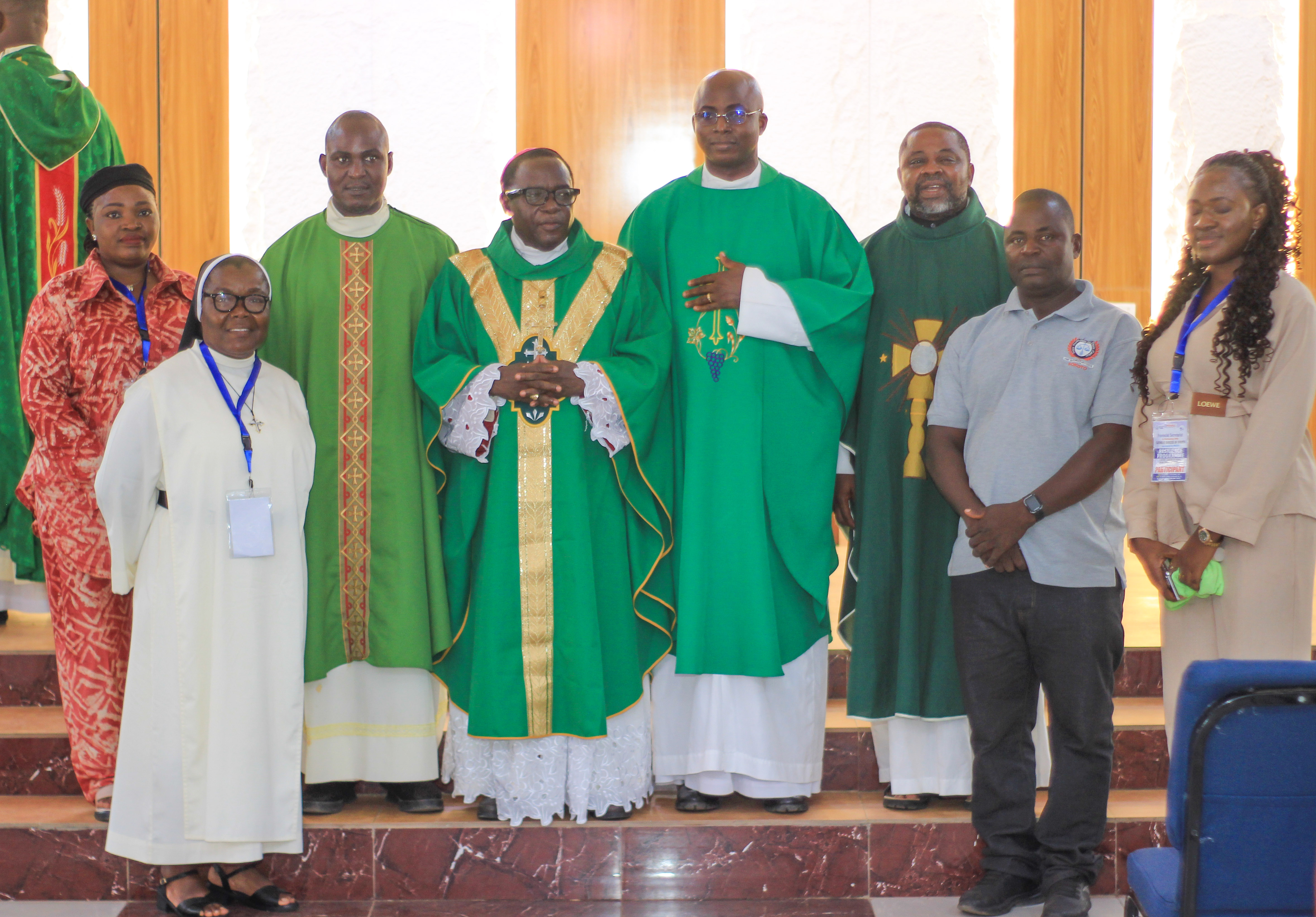
SOKOTO DIOCESE HOSTS RESILIENCE PROGRAMME FOR CLERGY, RELIGIOUS AND PASTORAL WORKERS.
Healing the heart of the minister

“Managing Diversity: Three Decades of Building a Cohesive Nasarawa State”
Bishop Matthew Hassan Kukah reflects on the issues, challenges and prospects of building a cohesive society in a diverse state.
To Conquer or to Serve?
Thoughts on the contributions of the Catholic Church to human development and the making of modern Nigeria.