Thoughts on the Contributions of the Catholic Church to Human Development
and the Making of a Good Society in Nigeria
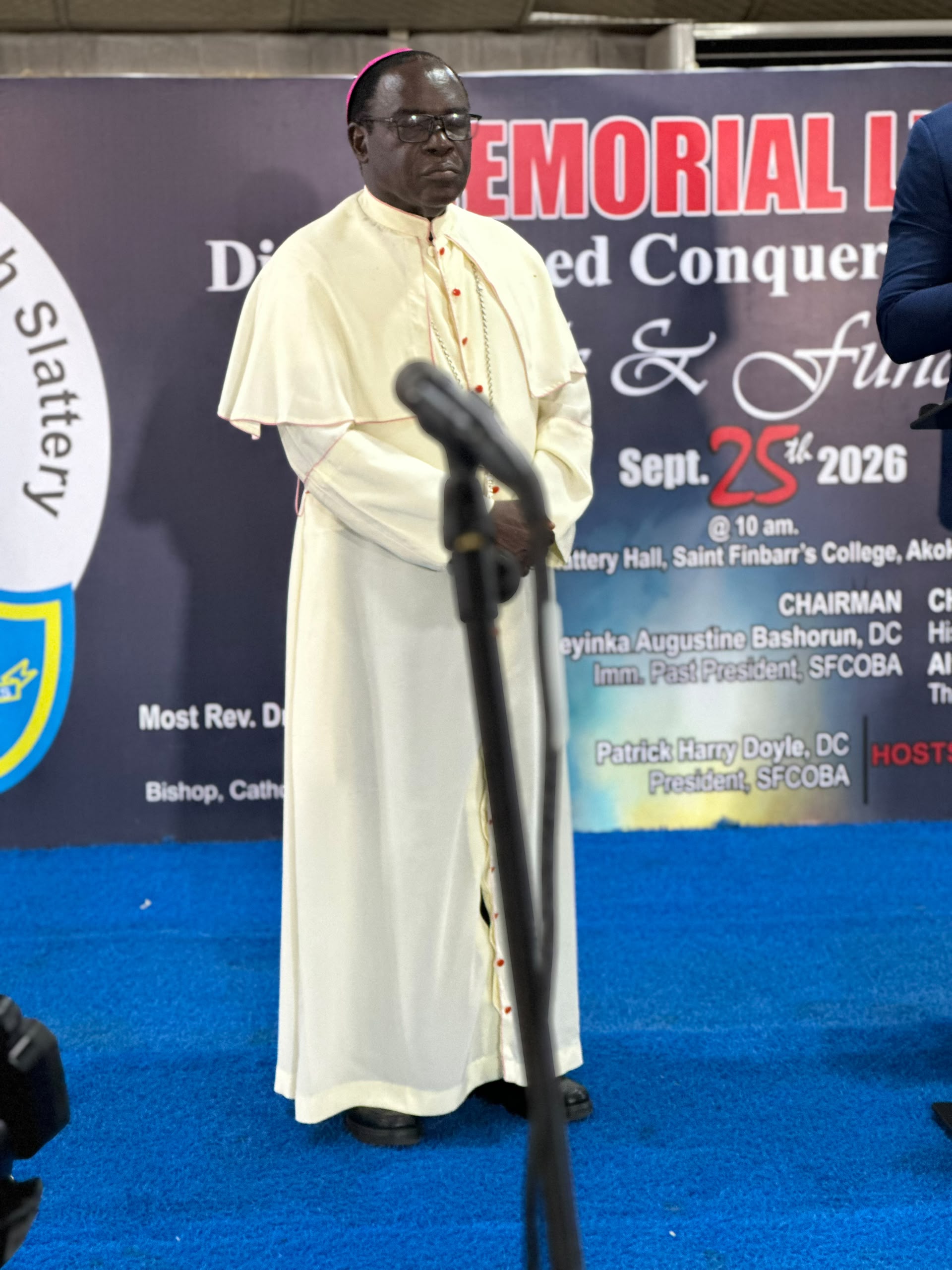
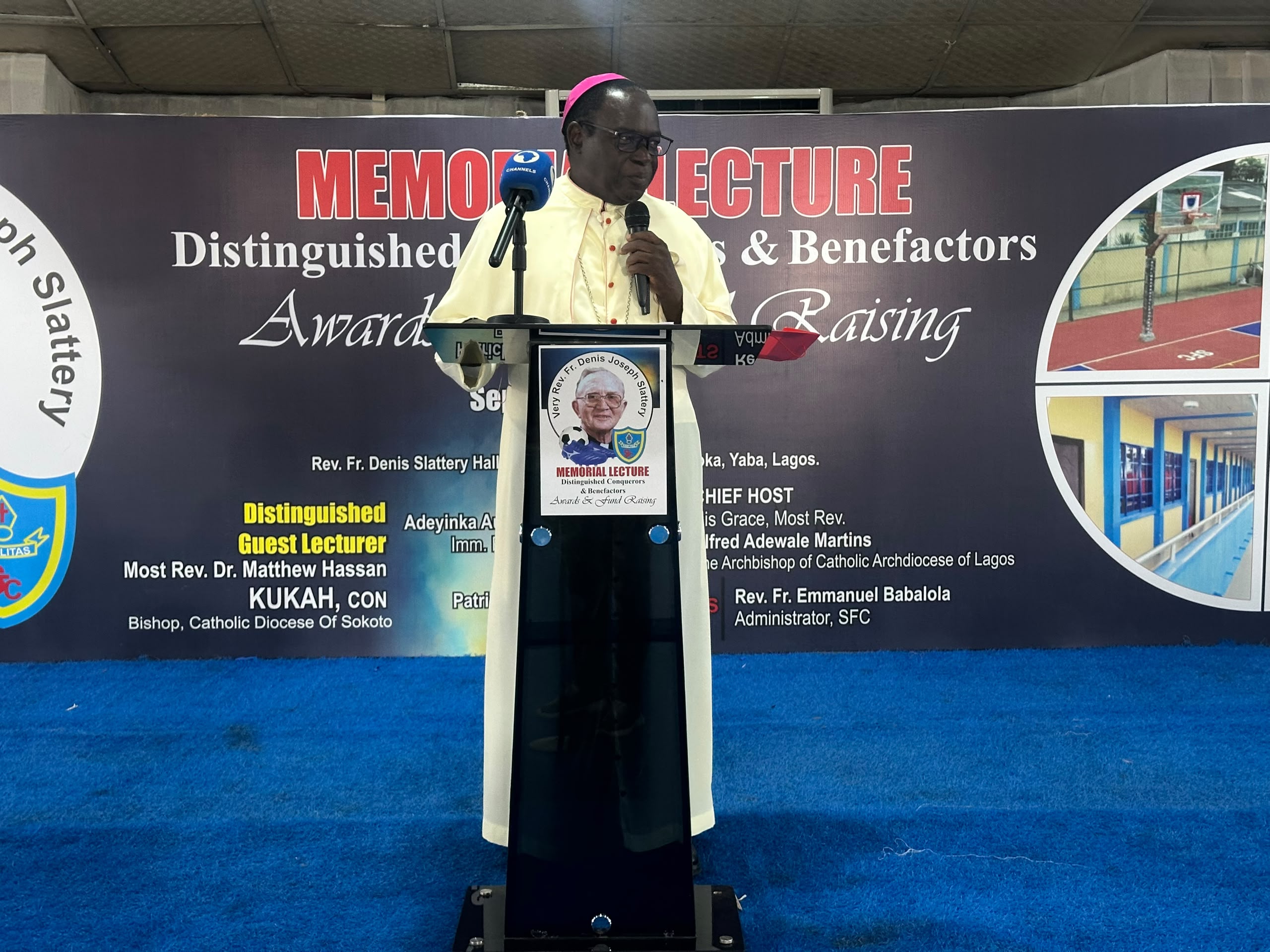
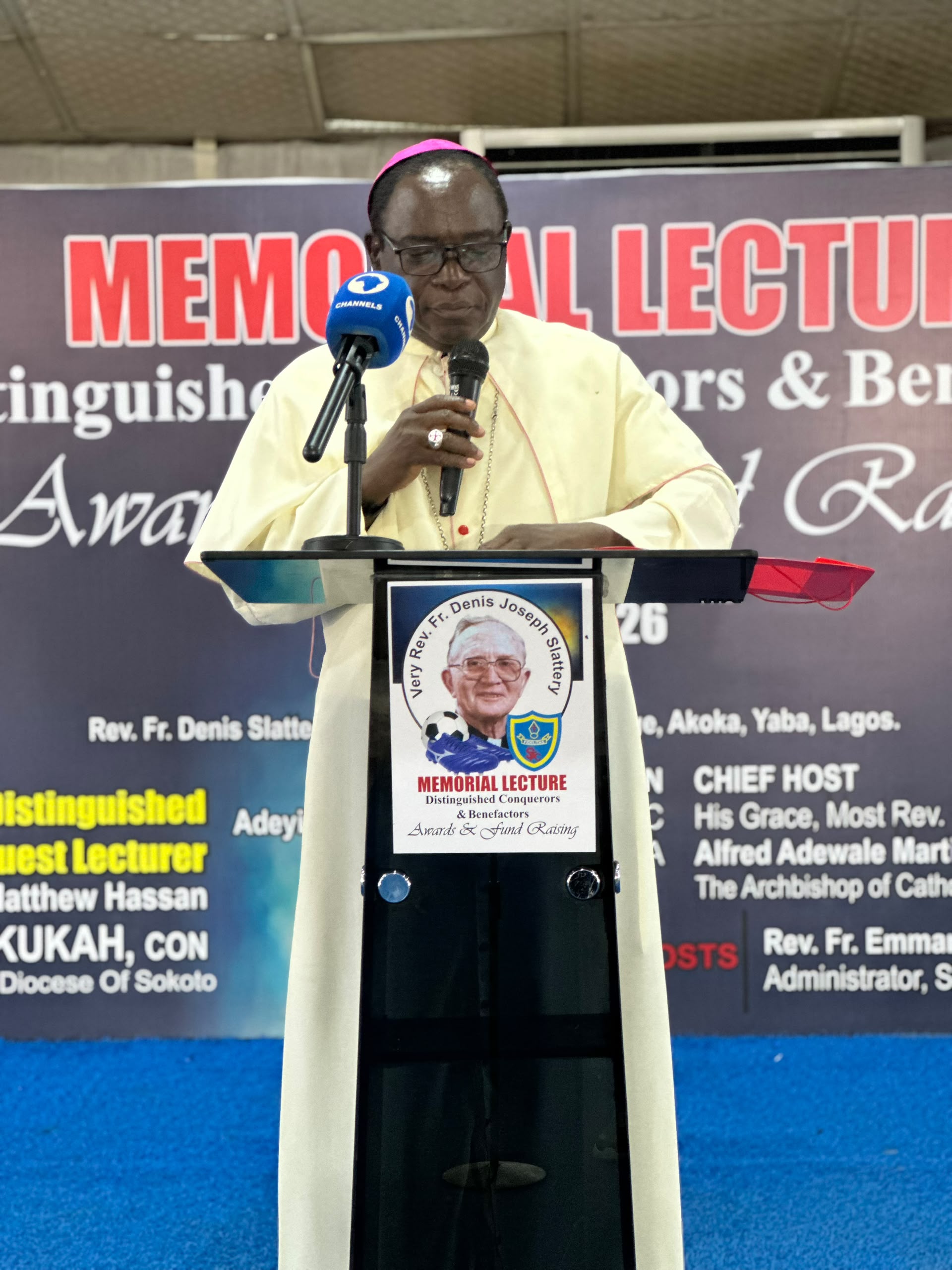
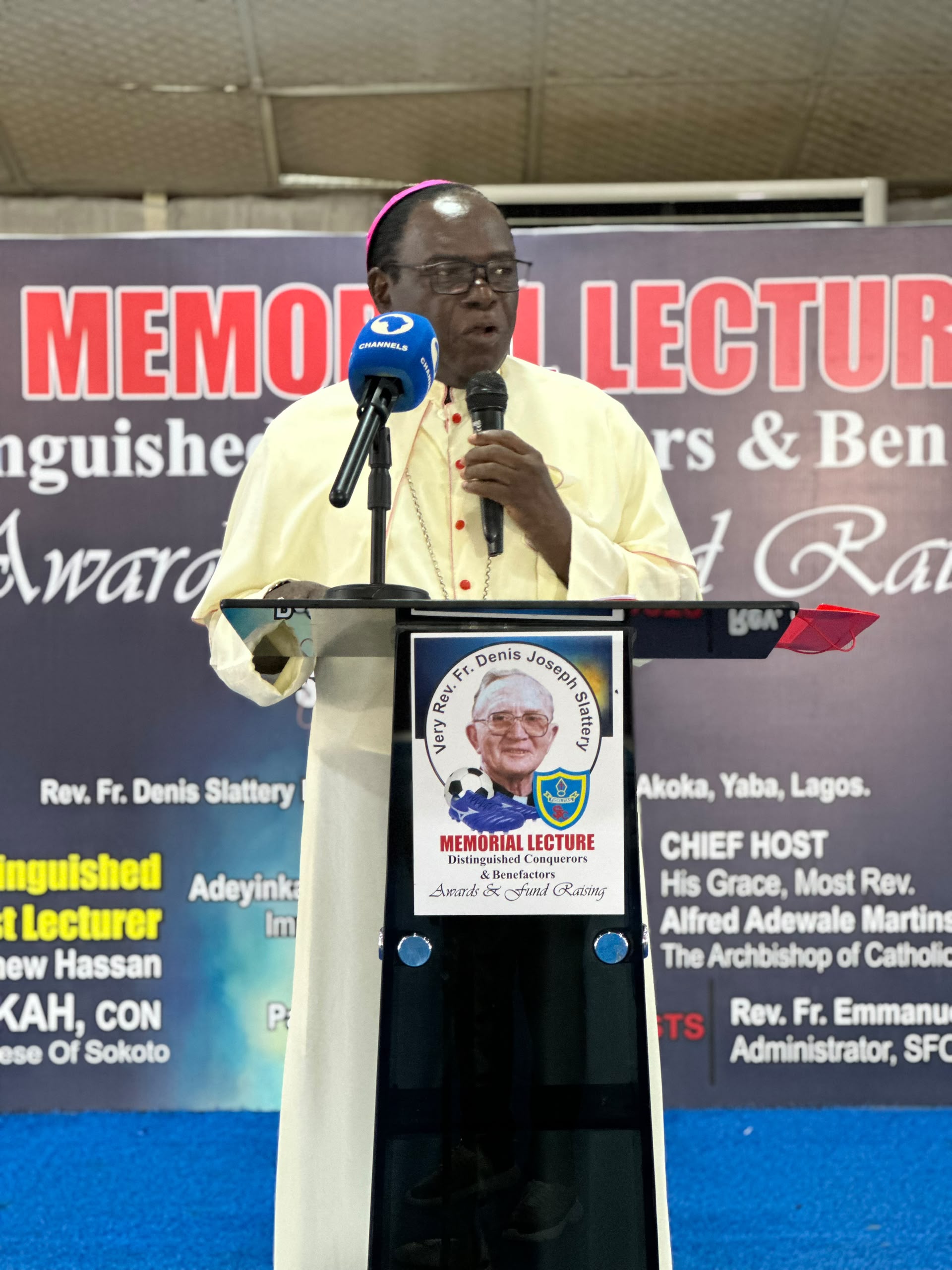
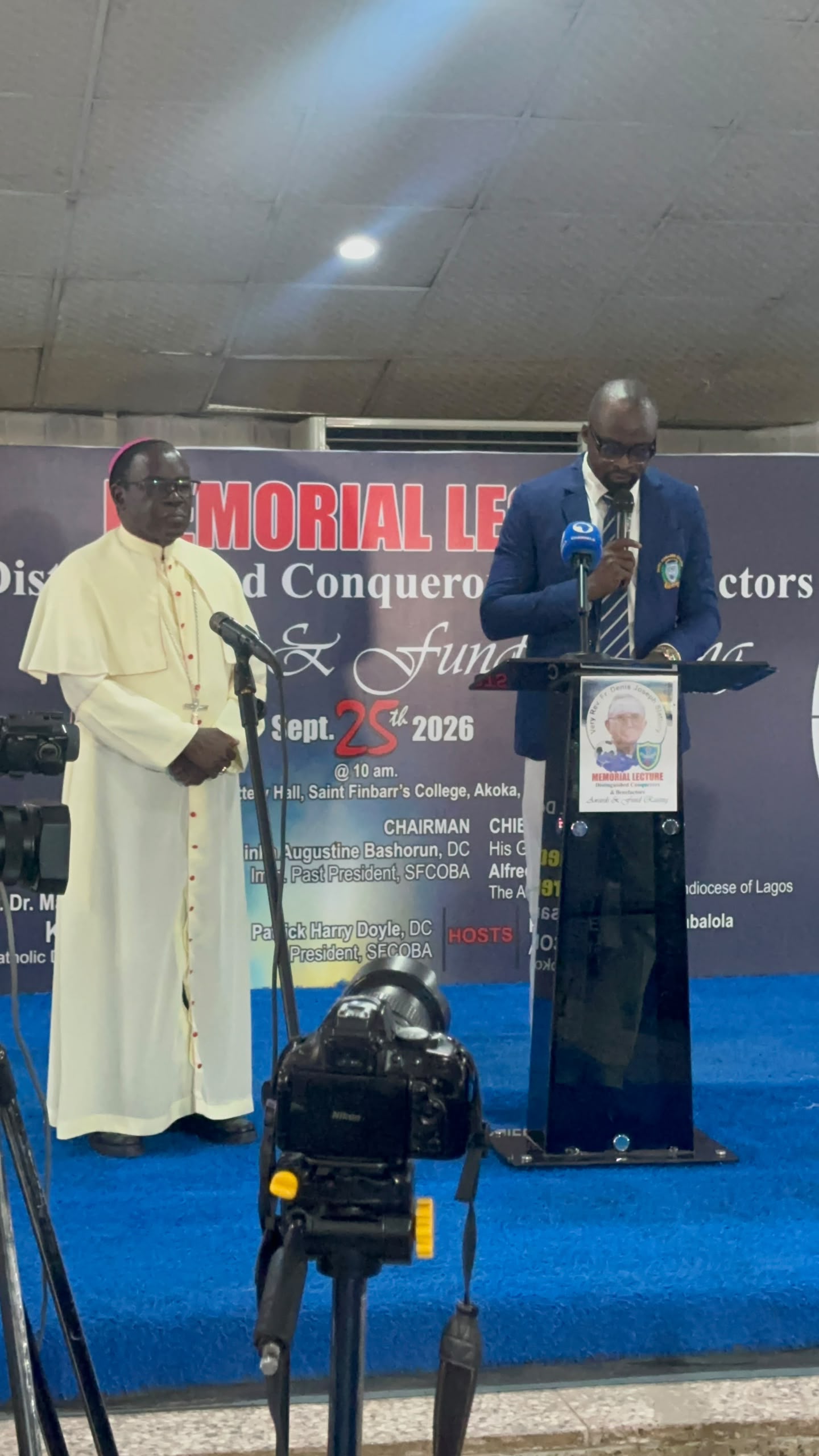
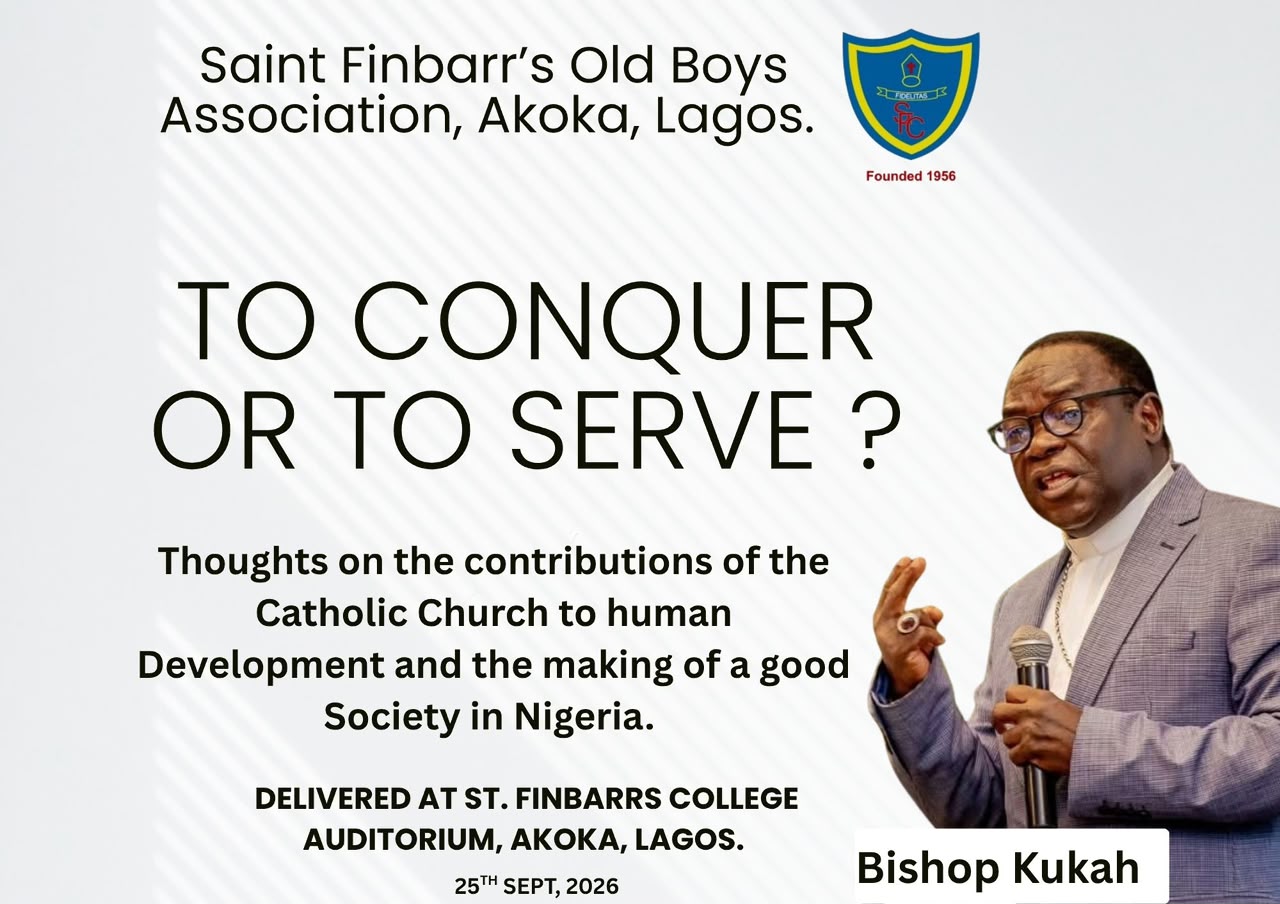
Delivered at St. Finbarrs College Auditorium, Akoka, Lagos on September 25th, 2026 by Bishop Matthew Hassan KUKAH, CON, Bishop, Diocese of Sokoto.
1: My intention in this lecture is to focus on what I consider to be the erosion of the influence of the Catholic Church in public life around the world, but particularly in Nigeria and to ask how this has come about. In doing this, I hope to challenge all of us to examine ourselves and ask whether we have lived up to the spirit that brought these great men and women to Nigeria and the legacy that they left behind. Therefore, there couldn’t be a better platform for this than the one you have offered me as we commemorate the life of a great man, Fr. Denis Slattery, a man I got to know, respect very much and could call not only my friend, but my good friend. We developed a great working relationship when, as Secretary General of the Catholic Secretariat of Nigeria, I had the honour of chairing the Board of St. Augustine’s College of Education, a job that had been assigned to my predecessors over the years.
2: I still have memories of our very first Board Meeting. We had started the meeting at about 9am and by about 1.30pm, we finished, just in time for lunch. Fr. Slattery, who had been sitting in the Council for quite some years, literally pounced on me, giving a great bear hug and saying; Congratulations and thank you very much Fr. Kukah. You conducted this meeting very professionally and you will be my friend for a long time. I am quite impressed. I have been on this Board for a long time but this is the first meeting we have finished before 5pm and we covered everything. From then, I was so humbled to have a relationship with a man who represented the best of the Irish missionary enterprise in Nigeria and elsewhere. That marked a relationship that went on until I left the Catholic Secretariat. So, when Patrick Doyle reached out to me and requested that I deliver this lecture, I was pleased to honour one of the greatest missionaries of our time. So, members of the Alumni Association, please accept my congratulations.
3: The late Professor Joseph Nye was one of America’s most consequential intellectuals. He rose to prominence during the Clinton years and capped his career by being the Dean of the Kennedy School of Government at Harvard University where I met him as a student. He treated me with deference when he realized that I had come to the Kennedy School after a stint at Oxford as a Senior Rhodes scholar. Both he and President Clinton had also been Rhodes scholars! He did a lot to shape American foreign policy. However, he is more remembered for articulating a theory of what he called, soft power. Coming through the Reagan years which had been marked by the Rambo, gung-ho belief that might is right and that America had a duty to enforce its will around the world, he sought to offer America a moral option built around the fact that its influence and power could be deployed in other ways, subtle but more enduring and effective. He argued that raw power was far less effective in creating and sustaining international and bilateral friendships with other peoples and nations. Soft power was the antidote, he argued. He then defined soft power as; The ability to shape the preferences of others to want what you want, to get what you want through attraction, by co-opting them through the attractiveness of your culture, political values and your policies, rather than coercing them with military force or buying them with money.
4: In almost every sense, this sounds like a text out of the teachings of our Lord and Saviour Jesus Christ, the kind of principles that the missionaries like Fr. Slattery espoused, the kind of force and passion that enabled them to set up institutions like yours. Today, you address yourselves as conquerors. This is what you were inspired to aim at. In order to be conquerors, you were given codes of conduct that focused on spiritual formation built around a disciplined life. The challenge now is, when you look back, how much of these values remained with you and how many of them still impact your life? In other words, did the inspiration from St. Finbarrs to seek to be conquerors stay with you, or, did these values fall by the wayside in the course of life, as you went through other competing institutions?
5: As you navigated universities here and abroad, some embraced new fraternities which has created serious moral conflict in the choices we make in private or public life today. We all navigate daily life through the management of all kinds of identities. We belong to different faiths, different ethnic and social clubs, different fraternities, political affiliations, among many others. Often, many of us have carried the ethos of these confraternities beyond our university days and they shape our choices today. Many of you who are reluctant to step up to serve in the Parish Council of your parishes, not ready to teach Catechism, join the Catholic Knighthood, are often passionately competitive and enthusiastic about serving as leaders in such confraternities as; Pyrates, Black or White Axe, Lagos, Ikoyi, Ikeja or Island Clubs, Golf or Boat Clubs, Ogboni and so on. While some of us have all the excuses in the world and are reluctant to serve in, or commit resources to the local parish Harvest and Bazaar Committees, we often have no qualms committing huge resources and time to these fraternities, ethnic or political associations. This is the background to what I consider to be the gradual erosion of Catholic values in our country today. This is because these associations have introduced often conflicting moral choices and diluted our true Catholic identity. Institutions compound loyalty in much the same way that banks compound money. Where we repeatedly invest our time, resources, friendships and ambition eventually forms us. If the parish receives the remnants of our time while other associations receive our best energy, we should expect those associations to exercise greater influence over our public choices.
6: Around the world, we are witnessing these serious reversals of the Catholic ethos in private and public life. Once we are unable to hand on to our children, a moral banner of Catholic values without stain, the future is in danger because, as we can see, over time, these moral values erode, diminish and finally even vanish from our moral choices. For example, in the early years of the European Union, there was a debate as to the contribution of Christianity in shaping the cultural and historical heritage of Europe. Almost all of these men and women had come from Christian backgrounds, but years of erosion of these values had brought them to this sorry state. This is akin to a young man coming of age and turning around to say that as he has matured, he had just discovered that his father is a eunuch! In all of these though, the flag of the European Union demonstrates what happens when Catholics take their faith to the public space. Arsene Heitz who designed what is now the European Union flag said he was inspired by our blessed mother, being a devout Catholic. He therefore used the Marian colour of blue and the twelve stars to honour our blessed mother whose twelve stars are mentioned in Revelation 12:1.
7: In 2020, I delivered a lecture in the House of Lords in London, UK. In the course of my presentation, I posed a question to the audience. I said: Looking back now, can anyone here point at a single Catholic President anywhere in the world today that we Catholics can hold up as a model, one that is proudly Catholic? No hands went up. I mentioned that the two likely countries we could look up to would be Ireland and the Philippines, two countries that until recently, had been 80 or 90% Catholic! At the time of the lecture, we could not fall back on Ireland because at that time, the Irish Prime Minister, the then, 38- year old, Leo Varadkar of Asian descent, had come out as a homosexual. In 2015, the same Ireland had voted Yes to same sex marriage and in 2018, repealed the ban on abortion.
8: In the case of the Philippines, in 2017, when the Catholic Bishops condemned the President’s arbitrary killings of people during his drug war, and referred to the times as a reign of terror, President Rodrigo Duterte called the bishops "sons of bitches". In 2020, when the Catholic bishops again called on Catholics not to vote for pro-abortion candidates, the President told them to; shut up and stay out of politics! I am calling attention to this so that we, who have come out of the womb of the church can learn our lessons.
9: In 1984, Richard Neuhaus, then a Lutheran Minister who later converted to the Catholic Church, published a very fascinating book that has stood the test of time and contributed greatly to shaping the way American Christians saw the role and place of Religion in public life in America. Titled, The Naked Public Square: Religion and Democracy in America, Neuhaus argued against the popular definitions of secularity of the state. If you create a neutral public space and try to push religion to the side, he argued, the space will not be a space without religion. Rather, he argued, it would be a state of many competing options trying to fill the void. Democracy, he believed has to be founded on sound moral foundations because its vision must be for a good society for all. Without a vision, as the scriptures say, the people will perish [ Prov. 29:18]. Morality will then become relative! The state can then fill this vacuum by creating what is called, a civil religion, manifested in the elevation of secular symbols, anthems, flags, or pledges to fill a religious void! The arguments he advanced are important for how our societies survive moral decline. The burden therefore falls on us to design a method of transmission of the discipline, values and virtues that we imbibed from Catholic education.
10: The history and legacy of the missionaries have become victims of deliberately distorted narratives. Nigeria’s historiography has largely been shaped through the very narrow lenses of Marxism. Marxism’s materialistic interpretations of the role of religion focused on seeing religion purely as a weapon of deceit, the so-called opium of the people. Since opium dulls the mind, Marxism tried to make the case that Christian missionaries essentially helped to soften the hearts of the African so as to reduce the harsh blows of colonial state. In the process, they couldn’t fight back. Yet, ironically, most of these scholars were themselves beneficiaries of missionary education.
11: The fullest expression of this is found in the famous anecdote often attributed to Jomo Kenyatta who was credited with saying: Before the white man came, we had the land, but we had no bible and we did not know how to read and pray. The white man came, gave us the bible, taught us how to read and pray. By the time the white man left, we opened our eyes, had the bible, knew how to pray but our land was gone! Of course, Jomo Kenyatta would concede today that it is the same missionary education that equipped his son to be able to become President!
12: In 1986, Professor Ali Mazrui of blessed memory popularized what could be presented as the Muslim view of the history of colonial and missionary engagement in Africa in his much-trumpeted 1986 BBC Documentary series: The Africans: A Triple Heritage. He deliberately distorted and tried to coalesce the work of the missionaries with the colonial state while ignoring the issues of the excesses of Islam in pre and post-colonial Africa. Today, Muslims in northern Nigeria have lived with the notion that Christianity came from the west and therefore it is seen as being part of the western world view. The Muslims themselves have refused to interrogate the Arab origins of their own faith and its consequences on the continent of Africa today from trade to slavery. Today in northern Nigeria, these prejudices drive the reluctance in accepting Christianity as being on equal footing with Islam in terms of rights. This is why you often hear the stories that conversions to Christianity by northern Muslims could lead to death or ostracization. It is responsible for the avoidance of mixing through such institutions like intermarriages between Christians and Muslims. This belief that Christianity is a product of the west accounts for why staging a Miss World contest in 2002, would lead to the burning and destruction of churches, why the killing of Osama bin Laden in 2011 or the drawing of cartoons against the prophet in far-away Denmark would lead Muslim youth to burn churches in northern Nigeria in 2005, or why the loss of elections by Buhari to Jonathan led to the destruction of Churches as we saw in 2011.
13: It is this hardening of positions within Islam that has made dialogue such a challenge. Islam in northern Nigeria came from a background of blood and conquest after the jihad that led to the establishment of the Sokoto caliphate. This is what has created the contrast in orientation between Islam and Christianity even in South-western Nigeria and elsewhere. For us, the Christian missionary enterprise arose from a burning desire by young men and women fired and inspired by the salvific message of Jesus Christ to share this good news with those who had not heard it. It was inspired by obedience to the great command of Jesus that his followers should take the gospel to all the ends of the earth [ Mk. 16: 15ff]. Thus, while their explorers and colonialists saw Africa as the heart of darkness, or the white man’s grave, inhabited by sub-humans, it was the missionaries that offered a counternarrative. Their message was that all human beings are created in the image and likeness of God and were therefore equal. They were driven by a different spirit and we can at least judge them by their fruits regarding the spirit that drove colonialism. As the Lord himself said: I The thief came to steal, kill and destroy, but, Jesus continued, I have come that you may have life and have it to the full [Jn.10:10]. There is no need for me to bore you with the intricate stories nor should we struggle to get into a debate over the revolutionary context of the message of Jesus and its impact in the world.
14: The Catholic Church illustrated that its mission was salvation, but salvation not as some inaccessible esoteric claims about a world that existed elsewhere. The missionaries believed that thoughts of heaven began from here on earth. They also believed it was important to equip its new converts with knowledge of heaven by offering them the tools to build a good life. Thus, almost everywhere the Catholic Church went, its missionaries sought to first offer the people education to enable them to access the word of God. The missionaries knew that education was the foundation of the good life and a good life. A good life, they thought would have come from a healthy body. This is why next to education they embarked on building Health facilities irrespective of how remote the communities were. These two key institutions became the magnet that pulled its first generation of converts, often, children first, and then their parents. That is why today, the Catholic Church remains the largest non-governmental provider of healthcare and education on earth. The Holy See’s Central Statistical Office reports that the Catholic Church has more than 231,000 schools and universities in 171 countries, educating 72 million students. In Africa alone, there are 21,091 Catholic nursery schools, 45,206 primary schools and 18,392 secondary schools: 84,689 educational institutions before Catholic universities and other higher-education institutions are even counted. And according to the 2025 Catholic Church Statistics published by Agenzia Fides, the Catholic Church operates 103,951 healthcare, welfare and charitable institutions worldwide. It was Saint Augustine that said: “Pondus meum amor meus". My weight is my love. Every institution reveals what it loves by what it builds. The Catholic Church reveals itself by what it built. Catholic statistics record that there are 5,100 Catholic nursery, primary and secondary schools in Nigeria - that is before Catholic universities and other tertiary institutions are counted. This means that these catholic schools, universities, hospitals and parishes still remain the major portals by which millions still pass through to have the best education. Yet, their values do not travel with the same force into our homes, professions, politics and public choices. Renewal requires these schools, hospitals and universities to carry conviction again into the lives of those who pass through them. This is why it remains a great tragedy that the federal government which took over schools continues to look away, reluctant to engage the church in finding the best way to rid our country of the forces of darkness that threaten to overwhelm us. Islam has no history of building schools or health facilities. It is not therefore strange that the products of these largely unsupervised Islamiyya schools have become incubators of toxic and skewed distortion of the faith and now a threat to the moral foundation and fabric of the faith and the our country at large.
15: Take a look at a list of some of the early Catholic missionary schools that produced our nation’s great statesmen and women and judge for yourselves. When you take the massive contribution of the other churches,0 you will appreciate the enormity of what we are saying and how Christian missionaries laid the foundation for the builders of modern Nigeria. Here are some examples from the Catholic Church.
16 : Christ the King College, Onitsha [1933], Sacred Heart College, Aba [1959], St. Michael’s College, Aba [1949], St. Charles College, Onitsha [1957], Bishop Shanahan College, Olu [1954], St. Augustine’s College, Nkwerre [1952], St. Peter’s College, Achina, Queen of the Rosary College, Onitsha [1928], Holy Rosary College, Enugu [1956], St. Agnes Girls, Grammar School, Enugu [1945]. In the north, St. John’s College, Jos, [1942], Our Lady of Apostles, Jos, [1953], St. Mulumba, Jos, [1959], St. Louis College, Jos, [1932], Enda’s College, Zaria, [1958], St. Mary’s College, Minna, [1965], St. Louis College, Kano [1960], St. John’s College, Kaduna[1952].
17 : Many of us can look back with some nostalgia about our times as first year students, the usual punishments that characterized initiations, the seniors we had to serve and how they mentored us, the various kinds of punishments we endured in the hands of some of them. We also have fond memories of a Rev Fr or Sister, our Teacher or Principal and their impact on who we are today. We remember all the efforts made to discipline us differently. We recall our pranks, our times as altar servers, stealing altar wine and so on. I saw a very interesting video some time last year, perhaps from the Philippines. Men in their 40s, 50s and 60s returned to their alma mater for an occasion such as yours. They were now distinguished men in public life, politicians, private sector executives and so on. However, on that day, all of them wore their school uniforms. One of them stood as the Father Principal at the top of a set of the steps in front of the Principal’s office which was still standing. They all lined up in their white school uniforms as it was in their days. They then came one by one to receive the cane on their back sides as it was in those days. The fake Father Principal was really serious because each of these men rubbed their bottoms as the cane landed on them! We know they were being punished for different infractions. These memories are sweet, but today, so much has changed. The implications are a topic for another day.
18: As I round up, let me restate the title of my presentation, to conquer or to serve? I chose it deliberately to speak to the conflicting cultures and history of modern Nigeria. We all agree that what is today modern Nigeria has come out of the womb of two colonizing empire building expeditions with contrasting and conflicting world views. First is the nineteenth century Sokoto jihadist escapade that left in its wake, a sprawling empire covering almost 400 thousand square kilometers. It was established on the debris and blood of millions of people who believed differently. The reign lasted almost a hundred years until it was overthrown by the British. It incubated almost two million slaves [1804-1903]. Next, was the British colonial conquest which entered what is today Nigeria in different phases and climaxed with the conquest of the caliphate in 1903. The destructive scope of British colonialism had similar bloody exploitation. Both projects caused a tectonic shift in the cultural plates of the peoples. Their impact is extant in the daily manifestations of tensions and differences among us. It is my view that till date, their legacies constitute significant reasons for the stagnation and seeming immobility of the Nigerian state. Thus, the violence that we experience in Nigeria today, derives from the nature of the ideologies of their historical entry into what is today modern Nigeria. Even today, areas that are contiguous with the conquered caliphate still insist on crafting Islamic law to the Nigerian constitution, showing clearly that the issues of conflict of laws remains unresolved and national integration and cohesion remains a project in suspended animation.
19: So, as I end, we must restate the mind and mission of Jesus who said at the beginning of his mission: my kingdom is not of this world [Jn. 18:36]. He said He would be with us till the end of time [Mt. 28:20]. Therefore, Christians must understand this fundamental distinction and difference between our beliefs and those of other faiths. No prophet ever made such the promise of an eternal kingdom because none claimed that; the Father and I are one [Jn. 10:30]. The difference between the kingdom of Jesus Christ and the conquerors and empire builders is that His kingdom is eternal. The world has had great empires, emperors and kingdoms, but where are they now? For example, the Assyrians lasted 302 years, the Romans 503 years, the Ottomans 623 years, the Persians 220 years, the Spaniards 406 years and Britain 400 years. In the end, all of these empires did not die: they committed suicide. This is because all became and reached a zenith, become obsessed with the allure of raw power, and are finally asphyxiated by a life of voyeurism. So, in the end, it is better to serve than to conquer. Jesus said: Behold, I come among you as one who serves [ Lk. 22:27]. So then, my title itself contains its own answer. The kingdoms of those who conquer by force are temporal. Christian conquer by serving and their kingdom remains eternal. Fr. Slattery conquered minds because he first gave himself in service. The missionaries conquered distance, ignorance, disease and isolation by building schools, hospitals and communities. Their conquest was measured by what they enabled others to become. All of you here are his testimonials.
20: Great men like Denis Slattery showed that in the end, it is not the size of the man in the fight, but really, it is the size of the fight in the man. He was a small man. To give you a sense, he looked to me! He came, he saw, he conquered. 70 years later, his image still looms larger than life. As a sign of appreciation, I encourage the alumni to be guided by the values that great men like Fr. Slattery espoused. Put the Beatitudes into practice. Be guided by the Catholic Church’s teachings on virtue and a good life. I just finished reading Joseph Stiglitz’s book, The Road to Freedom: Economics and the Good Society. It is a tirade against neoliberal capitalism and its corrosive effect on the poor and the larger society. He is making a case for the construction of a more humane and egalitarian society. This message is at the heart of the one who said, I have come that they may have life and have it to the full [Jn. 10:10]. So, yes, if we were using the values of Jesus then we should be showing the way to how a good society should look like. Where we can say with the Psalmist, how lovely it is to see brothers and sisters living together in unity [Ps. 133:1]. And, Fr, Slattery and the missionaries, by teaching us to serve, already showed us the sense of urgency in building a good society, one in which we are all servers and not conquerors. In his epic encyclical, Magnifica Humanitas, Pope Leo has asked us to choose whether we, seduced by human arrogance wish to build the tower of babel, marked by human greed and arrogance or, if, like Nehemiah, we will put comfort aside and build the broken world of our society. The choice is ours to make. I know we would rather be Nehemiahs.
Thank you very much.